
The joint statement was issued during Pakistan Prime Minister Shehbaz Sharif's recent visit to China.

At the same time China said that it does not mean China should "appease" India to prevent it from playing "little tricks".

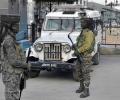
Suspected insurgents have abducted four policemen and their official vehicle in Gwadar, Balochistan, a sensitive region vital to the China-Pakistan Economic Corridor. A search operation is underway, with initial investigations suggesting the police were involved in illegal detentions. The incident occurs amidst ongoing anti-terror operations and recent attacks in the province.
"India should share the fruits of future development by shelving the anti-Pakistan activities and subversion," Lieutenant General Aamir Riaz said.

Pakistan Prime Minister Shehbaz Sharif will take the USD 60 billion China-Pakistan Economic Corridor forward with new vigour, vitality and in a rejuvenated manner, ensuring the multifaceted development of the flagship project of China's ambitious Belt and Road Initiative, a top leader of the ruling PML-N has said.

Gwadar is viewed as a critical pearl in China's maritime strategy as it would give a permanent logistical footprint near an important choke point - the Strait of Hormuz and the oil rich Persian Gulf, explains Commodore Venugopal Menon (retd).
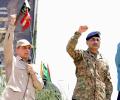
Pakistan Army Chief Field Marshal Syed Asim Munir has described militants operating in Balochistan as 'foreign-sponsored proxies' actively working to destabilise the province and obstruct its development.

China has established a new county in Xinjiang province near Pakistan-occupied Kashmir (PoK) and the Afghanistan border, a move seen as strengthening security along the Wakhan Corridor and addressing concerns about Uyghur separatist militants.
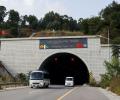
A senior Pakistani minister has admitted that the country failed to capitalize on the China-Pakistan Economic Corridor (CPEC), citing attempts by the previous government to undermine Chinese investments, leading to investor flight.
China has reaffirmed its territorial claims over the Shaksgam Valley, dismissing India's objections to infrastructure projects in the area. The Chinese Foreign Ministry spokesperson stated that the territory is part of China and its activities there are beyond reproach.

Bangladesh-China and Bangladesh-US relations have evolved from reluctant engagement to increasingly consequential strategic partnerships.

India on Monday voiced its concern to China over its plan to build a multi-billion dollar Economic Corridor to Pakistan through POK, even as it assured Beijing of its commitment to consolidate strategic bilateral ties.

Seeking to allay India's concerns, ambassador Luo had offered to rename the CPEC which passes through Pakistan-occupied Kashmir, insisting it was an economic cooperation and connectivity enhancement project devoid of "sovereignty issues".
'China's basic purpose of taking the Shaksgam Valley was access to the Indian Ocean.'

'China continues to perceive its relations with India through the prism of India-US relations, with the US using India to counter balance against China in the Indo-Pacific and beyond.'
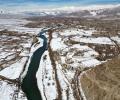
China and Pakistan concluded their strategic dialogue, reiterating their opposition to unilateral actions in South Asia and discussing Kashmir, Afghanistan, and trilateral cooperation.
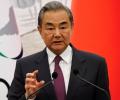
China on Tuesday called for a 'comprehensive and lasting ceasefire' between India and Pakistan, urging both countries to properly handle their differences through dialogue.

"China is an absolutely impossible factor to ignore in what has been our confrontation with Pakistan," Tharoor said.
'If they can be duplicitous, we can be equally duplicitous.' 'If they offer friendship, we reciprocate.' 'If they choose hostility, we respond with equal hostility.'
The announcement on expansion of CPEC was made following a meeting among Chinese Foreign Minister Wang Yi, his Pakistani counterpart Ishaq Dar and Afghanistan's Acting Foreign Minister Amir Khan Muttaqi in Beijing, according to a Pakistani readout.

'We need to give Pakistan something serious to think about on its eastern front -- that is the only way to actually help Afghanistan right now.'

This move is seen as part of efforts to strengthen China's ties with Pakistan and safeguard Chinese investments in Pakistan-occupied Kashmir, particularly related to the China-Pakistan Economic Corridor.
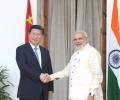
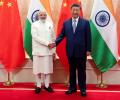
The Modi-Xi meeting assumes significance as India-China relations have followed a southward trajectory over contentious issues.

Chinese Foreign Minister Wang Yi on Friday met Pakistan Army Chief Asim Munir and discussed regional security, counter-terrorism and matters of mutual interest.

'Should China's interest in the Teesta River projects be approved, it would likely result in heightened Chinese presence near the Siliguri corridor.'

The blast ripped through a busy street close to the headquarters of Frontier Constabulary (FC) in Quetta, capital of the province.

Pakistan's Army Chief Field Marshal Asim Munir met with Chinese President Xi Jinping, along with Pakistani Prime Minister Shehbaz Sharif, to discuss bilateral and regional cooperation. The meeting occurred during Sharif's visit to China for the Shanghai Cooperation Organisation (SCO) summit.
The Union territories of Jammu and Kashmir, and Ladakh are and will always remain an integral and inalienable part of India, the MEA said.

With general government debt now approaching three-quarters of GDP, and only incremental reform efforts visible, Pakistan risks prolonging its economic stagnation unless fundamental governance, regulatory, and industrial overhauls are undertaken.

Pakistan has approached the Asian Development Bank (ADB) for a USD 7 billion loan to upgrade a major railway line after China apparently declined to support the project. The development of Mainline-I (ML-I) railways between Peshawar and Karachi is stuck due to a lack of funds.
Pakistan's deputy Prime Minister and Foreign Minister Ishaq Dar, who is in China on a four-day visit, and Chinese Foreign Minister Wang Yi co-chaired the fifth round of the foreign minister-level China-Pakistan Strategic Dialogue.
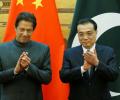
Pakistan and China on Wednesday inked several agreements and memoranda of understanding, including a pact on a system to manage the border between the Xinjiang autonomous region and Gilgit-Baltistan area. President Asif Ali Zardari and visiting Chinese Premier Li Keqiang witnessed the signing of the agreements by representatives of the two countries during a ceremony at the presidency.

'The flip side of this is that he won't hesitate to call out India if he thinks its policies are hurting US economic interests or border US foreign policy goals.'

The US intelligence assessment highlights Pakistan's near-certain procurement of weapons of mass destruction-applicable goods from foreign suppliers, primarily through Chinese support.

'The BNP's election manifesto lists grievances against India, mirroring the attitude of past BNP governments.' 'Political parties have been careful not to say bad things about China.'
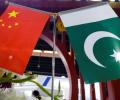
As China's Foreign Minister Sun Weidong visited Pakistan on a mediation mission, a statement from Foreign Ministry on Monday said it is maintaining close contacts with Pakistan and Iran to 'bridge their differences'.

External Affairs Ministry Spokesperson Raveesh Kumar also talked about the China-Pakistan economic corridor in Pakistan-occupied-Kashmir, asserting that India is 'resolutely opposed' to any actions by other countries to change the status quo in the region.
Gilgit Baltistan's large frontage with Kashmir and Ladakh across Kargil and the Siachen Glacier gives Pakistan and China the perceived scope for conduct of collusive operations against India and wrest control of the major course of the Indus and Shyok, observes Lieutenant General Syed Ata Hasnain (retd).
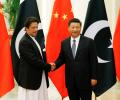
'Listing Masood Azhar as a 'global terrorist' was done with Islamabad and Imran Khan's concurrence.' 'It was not prompted by the so-called 'Wuhan spirit'.' 'The relationship between the two 'iron brothers' has not been dented,' points out former RA&W officer and China expert Jayadeva Ranade.
Prime Minister Shehbaz is himself overseeing the security of the Chinese projects and engineers.
